

Beginning in fall 2026, the SHSAT becomes a computer-adaptive test. Students will take the exam on DOE-provided computers, and the test will adjust question difficulty based on student responses. Every student will still answer the same number of questions — 50 ELA and 50 Math — and be tested on the same grade-level standards, content areas, and item types. What changes is the difficulty path each student sees. For parents, the key takeaway is simple: the format is changing, but the skills are not. Students still need strong mastery across the core SHSAT topics, and an adaptive test may expose weak areas faster — which makes structured topic mastery, personalized study plans, and targeted practice more important than ever.
What Changed About the SHSAT in 2026?
One of the most significant changes to the SHSAT in decades: starting fall 2026, the SHSAT is a computer-adaptive test (CAT), administered fully on DOE-provided computers.
A computer-adaptive test adjusts its content based on how the student is doing. At the start, every student sees an item or passage set of average difficulty. After each response, the system re-estimates the student's score in real time. Answer correctly and the estimated score rises, and the next question may be harder. Answer incorrectly and the estimate drops, and the next question may be easier. The test keeps adapting the difficulty level as the student progresses.
The exam still has two sections — English Language Arts (ELA) and Mathematics — with 50 questions per section and a standard testing time of 180 minutes. Students choose which section to begin with.
Does Adaptive Mean Every Student Takes a Different Test?
No — and this is the part most parents get wrong. Every student answers the same number of questions (50 per subject) and is tested on the same grade-level standards, content areas, and item types. What adapts is the difficulty of the individual questions a student sees, not the topics or the length.
So two students can sit side by side, answer the same number of math questions on the same skills, and see questions of very different difficulty — because the test is constantly calibrating to each student's estimated ability.
The Format Changed. The Skills Did Not.
Adaptive testing doesn't change what students need to learn. Students still need to master inference, central idea, revising and editing, algebra, geometry, probability, and the other skills that have always appeared on the SHSAT. What changes is how quickly the test identifies strengths and weaknesses.
That's why SHSATlab continues to focus on topic mastery first. The adaptive engine may change question difficulty, but it still rewards students who have built strong fundamentals across all 30 SHSAT topics. If anything, the new format raises the stakes on mastery: a weak area may become more apparent as the adaptive test gathers more information about a student's performance.
The takeaway for families is simple. Don't chase the format. Build the fundamentals. A student with deep, durable command of every tested topic is ready no matter how the questions are delivered.
How Is the Computer-Adaptive SHSAT Scored?
Your score is based on the pattern of correct and incorrect answers relative to question difficulty — not a simple count of how many you got right.
Each item has an established difficulty parameter, all placed on the same measurement scale. As the test progresses, the student's estimated score updates after each response (or after each passage-based set in ELA). At the end, a final performance score is computed and transformed into the reported SHSAT score.
That final step hasn't changed: performance scores on each subtest are standardized into scaled scores, and the two scaled subtest scores are added together to produce a composite score used for rank ordering — the same conversion process used on past SHSATs.
The practical takeaway: a smaller number of hard questions answered correctly can be worth more than a larger number of easy ones. On an adaptive test, the ceiling matters.
Why Topic Mastery Matters More Under an Adaptive Test
On an adaptive test, strong students get pushed toward the hardest questions in the bank. That's by design — the system is trying to find the edge of what each student can do. The students who hold up are the ones with genuine depth in each topic, not a thin, grade-level-only familiarity.
This is exactly why surface-level review isn't enough anymore. If a student has only ever seen the easiest version of a skill, the adaptive engine quickly serves something harder — and that's where points slip away near the top, where admission is decided.
Recent cutoff scores show how competitive admissions remain, especially for schools like Stuyvesant, Bronx Science, and Brooklyn Tech. Reported 2025 cutoffs included approximately 556 for Stuyvesant, 518 for Bronx Science, and 505 for Brooklyn Tech — but cutoffs change every year based on student scores, school rankings, and available seats. The bigger point is simple: a small performance difference can separate an offer from no offer. Deep, durable mastery across all 30 topics is what protects a score when the test probes a weakness.
How SHSATlab Builds Topic Mastery
SHSATlab is built around topic mastery. Each of the 30 SHSAT topics is its own unit, and within every unit, practice progresses through four levels so a student moves from foundational understanding to advanced mastery one skill at a time. Get 10 correct in a row, and the next level unlocks.
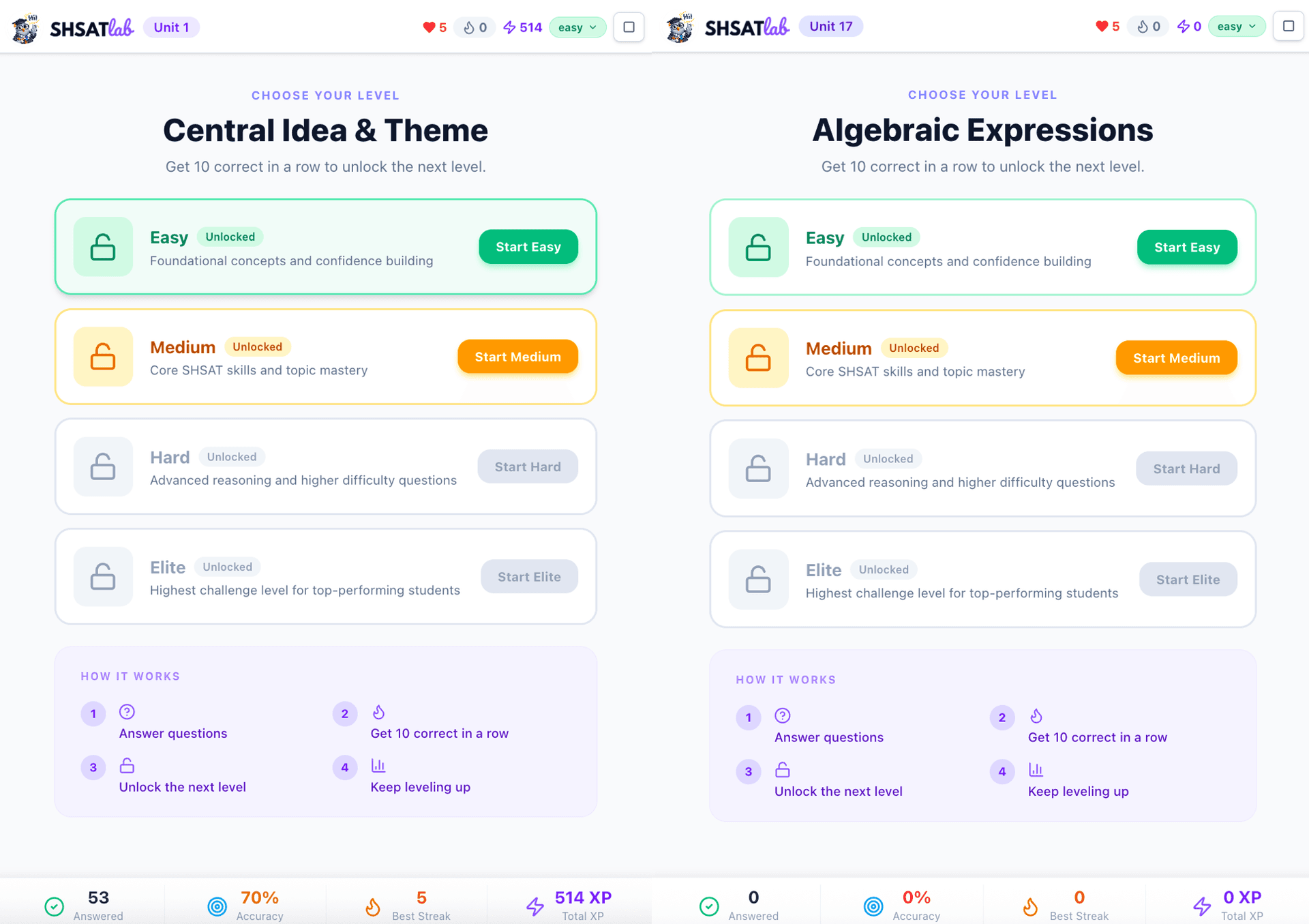
The four levels build a topic from the ground up:
This is exactly what an adaptive test rewards. The engine may change question difficulty on test day, but it still measures whether a student has truly mastered each topic. A student who has worked a topic up through every level isn't thrown when the test probes that skill harder — they've already built the depth the adaptive format is looking for.
SHSATlab is a preparation tool, not the official scoring engine. What it builds is mastery: real, level-by-level command of every skill the SHSAT tests — which matters more under an adaptive format, not less.
See Where Your Child Actually Stands
Every SHSATlab journey starts with a free, full-length diagnostic. One test produces a score estimate, a section-by-section breakdown, and accuracy across all 30 SHSAT topics — then turns that into a personalized plan.
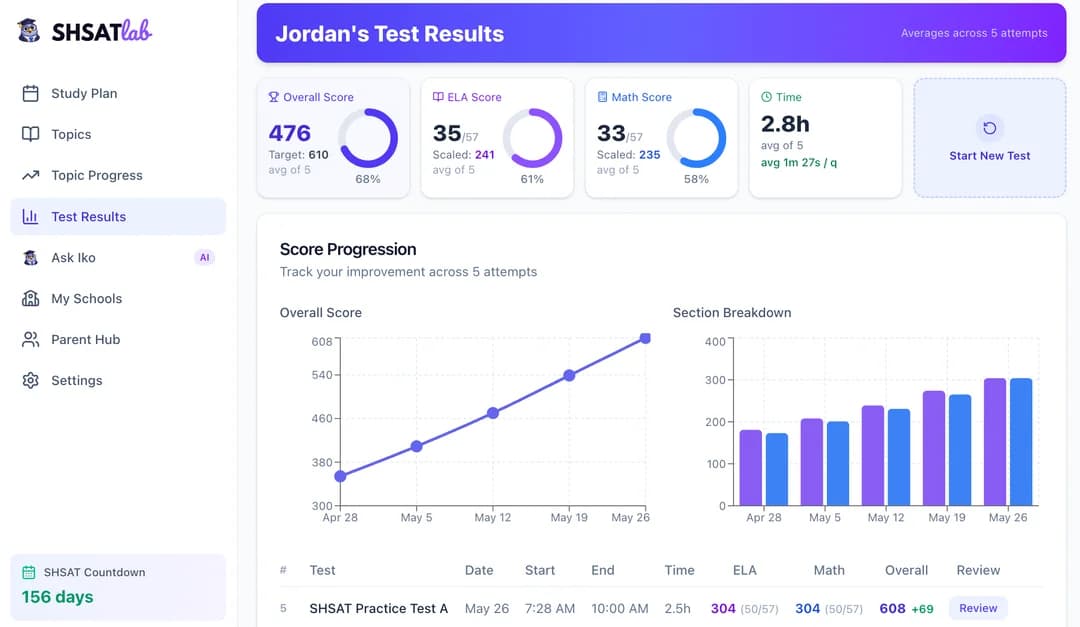
On an adaptive test, knowing your child's actual strengths and weaknesses matters more than ever. A student who is strong in ELA overall but misses every Inference question has a specific, fixable weakness the adaptive engine will find fast. A single composite score hides that. The topic breakdown surfaces it.
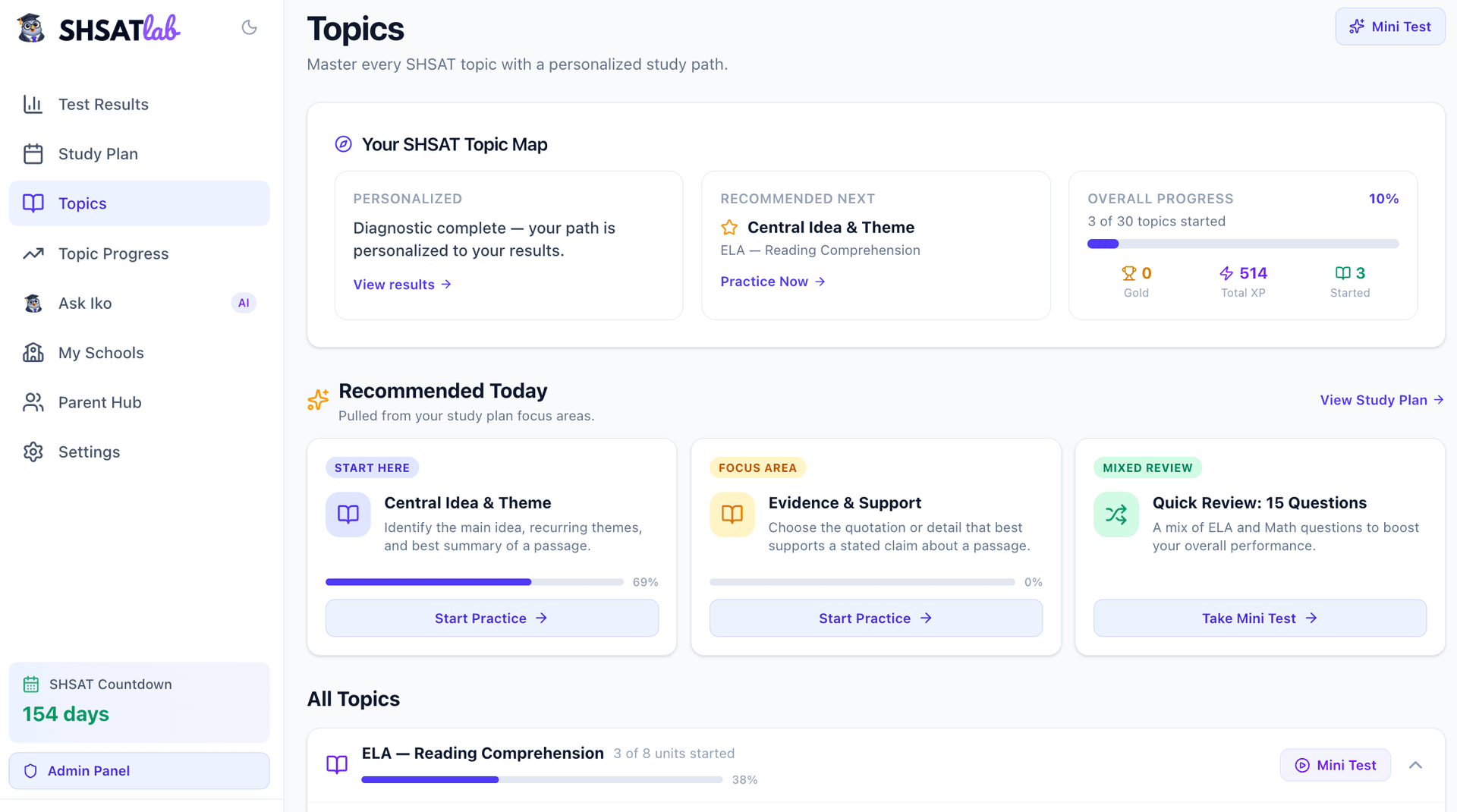
From there, SHSATlab's structured SHSAT framework turns the diagnostic into a week-by-week plan that targets the weakest, highest-impact topics first, then ramps difficulty as the student improves.

Don't Forget the Digital Question Formats
The adaptive SHSAT is also a digital test, which means Technology-Enhanced Items (TEI) — drag-and-drop, multi-select, grid-in numeric entry, inline dropdowns, clickable text, and number-line graphing — alongside multiple-choice and fill-in-the-blank questions.
A student who meets an inline dropdown for the first time on test day loses seconds just figuring out the mechanics — and on a timed, adaptive test, seconds are points. SHSATlab practices every one of these formats so nothing on the screen is a surprise. (For a full walkthrough, see our guide to SHSAT question types and TEI formats.)
It's also worth knowing the navigation rules: students must answer each question before advancing. Within an ELA passage set you can revisit and change answers until you submit the set; after that, and for all Math and stand-alone ELA items, you cannot go back. Practicing under those same constraints — commit to an answer, then move on — builds the decisiveness the format demands.
What Parents Should Do Now
If your child is taking the SHSAT this fall, now is the time to start. Families should not wait until September — the earlier students identify weak topics, the more time they have to fix them. Here's the short version:
The students who start now have time to run a full plan, build genuine mastery across their weak topics, and walk in ready for whatever difficulty the adaptive engine serves. The students who wait until September start from the same place with far less runway.
The adaptive SHSAT may change how questions are delivered, but it doesn't change what students need to learn. The students who build strong fundamentals and master each topic will be best positioned for success.
What Parents Should Remember
For more on the app behind this approach, see our breakdown of the best SHSAT prep app for 2026.